The Edible Garden at the Oregon Gardens
by Jude Hobbs and Rose Marie Nichols
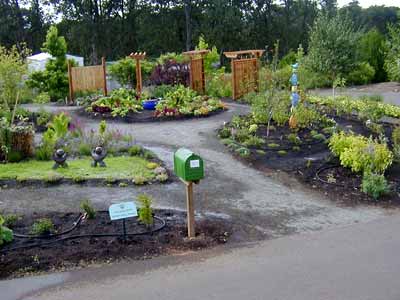
Entry
to Edible Gardens
It's
worth traveling off the beaten path (I-5) to visit the Oregon
Gardens, a
70 acre Botanical Park located in Silverton. It all started
in the 1940s
when the Oregon Association of Nurseries (OAN) came up with
the
idea. It took 40 years, but in the ''80's the City of Salem
took hold
of the idea and started contemplating the Master Plan which
was
completed in 1996. The only feasible cost effective way
to pull
something this momentous was to partner with many organizations
and
businesses, such as: governmental and tourism officials,
local
citizens, industry, educational institutions. Ground was
broken in
1997 and since then it has been a work-in-progress. This
year is the fifth
season for the garden and the plantings are developing in
size and
character.
The site was selected as a solution to the problem of where
Silverton
was to discharge its treated wastewater. From May to September
the sophisticated water treatment process is utilized. Treated
wastewater leaving the Silverton Wastewater Plant exceeds
the stringent standards of EPA and Oregon's Department of
Environmental Quality. The City discharges the treated wastewater
to both Silver Creek and the Oregon Garden. The Garden recycles
the water through landscaping irrigation and wetlands features.
There are 18 diverse specialty gardens all with unique characteristics.
The Water Garden is 1060 feet long with sixteen terraces
that fall
over 37 feet of grade.
The
Children's Garden is nearly an acre and has a Dinosaur Topiary,
an
amphitheater with a child pleasing echo-chamber,
a Bamboo Grove and the Taper Tunnel. There many
other theme gardens such as the Rose Garden, a Conifer Garden
that is truly
world class and the Sensory Garden.
Our involvement with the Nichols Garden Nursery/One Green
World home
demonstration garden has been to present to Oregonians and
visitors from
around the world how one can incorporate food, medicinal,
bird
attracting plants in a fun and educational display. The
Edible
Garden is the newest addition to the Home Demonstration
Garden area.
We are the showing off the latest trends in vegetables,
fruits, vines and
herbs of these premier growers.
 |
|
Art
in Edible Gardens
|
Co-designed
by Jude Hobbs, of Cascadia Landscape Designs and Liz Deck
a landscape Architecture student from the University of
Oregon along<
with the plant providers, the renowned Nichol's Garden Nursery
with Rose
Marie Nichols McGee and One Green World's Jim Gilbert. Both
of these
nurseries are unique in the wide scope of plant species
that they
offer for the edible landscape. The Garden features plants
with a purpose that are placed in beautiful design patterns.
The
breeding efforts and plant material from other local grower's
has
contributed to this garden as well; Alan Kapuler from Peace
Seeds in
Corvallis has bred Metamorph marigold and Sunflower Supreme
Mix, an
exquisite example of open-pollinated sunflowers. His pioneering
work on Oca
and Yacon, both South American tubers can be enjoyed in
the foreground of
the garden. Frank Morton, of Wild Garden Seeds in Philomath,
has been
breeding beautiful and good tasting lettuces and garden
greens which are
showcased in the salad circle. Representing the research
of the department
of Horticulture at Oregon State University is Legend Tomato,
the first ever
late blight resistant tomato and Oregon Sugar Pod II the
world's most widely
grown edible pod pea.
Divided
into several small sections the edible garden features:
* A Tea garden - Camellia sinensis, our source of true tea,
mints developed in
Oregon and other herbs good for tea. An Insectory garden
with plants that
attract insects that are pollinators and others that harbor
predators to
insects that cause damage to plants. Limnanthes douglassii,
Meadow Foam,
attracts the predatory syrphid fly as well as bees.
The
Salad circle - is a colorful exhibit of how to combine salad
greens, tomatoes, nasturtiums. This is now replanted for
fall with colorful
kales, rainbow Swiss chard and lettuces. the nasturtiums
are producing a
glorious late season flash of color.
A
small planting of Nichols Ecology lawn is an alternative
turf mix of a low
growing grass, nitrogen producing clovers, hardy yarrow
and wild English
daisies. It does not require a rigorous maintenance schedule
and is fairly
drought tolerant.
The straw bale garden has been a source of intense interest
from garden
visitors. This easy to grow display has featured lettuce,
mesclun mixes,
peas and green beans this season. Wheat straw bales provide
the base,
compost the seed bed and with a good dose of compost tea
and legume
inoculant for the peas and beans they've taken off and been
very productive.
One of our objectives is to demonstrate methods for those
who garden in
limited space. The bales and container plantings provide
some new ideas for
gardeners. The panels covered with growing vines are a way
to gain privacy
and shade while growing food in a small space.
The
Edible Garden demonstrates what we can easily grow in the
Pacific
Northwest. A stroll through the garden gives one the opportunity
to
see what plants to combine with each other and possibilities
to incorporate
into the food gardeners own plot.
--
You can contact Jude Hobbs at hobbsj@efn.org
or 541-342-1160
Marie Nichols McGee at 800 -231-5306 - www.nicholsgardennursery.com
or Jim Gilbert at 503-651-3737 One Green World